

Remembrance season has prompted a 93-year-old Hampshire care home resident to share childhood memories of living on the Channel Island of Jersey at the time of its Nazi occupation in World War II.
Born in the island capital of St Helier in 1932, Edward Michael McFarling, known as Michael, was just nine years old when the German military landed.
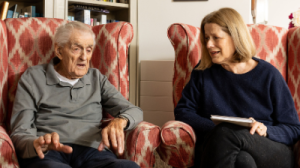
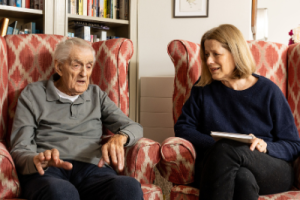
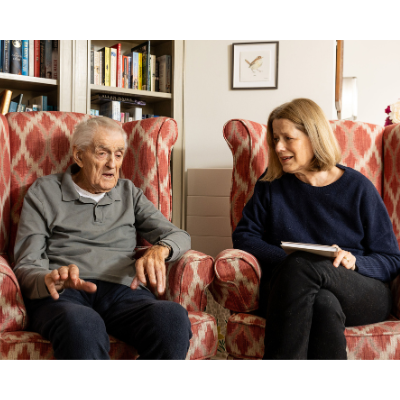
During a series of reminiscence sessions for residents at Colten Care’s Winchester care home Abbotts Barton, where he has lived since June this year, Michael spoke of the impact the invasion had on him and his family.
“My brother and I were walking back from school and I remember my mother wasn’t there when we got home,” he said. “As we started walking to our grandparents, we met her along the way and were scolded. She said we should be inside because they had bombed and killed quite a few people. It was terrifying.
“When war broke out there were attempts to evacuate as many British people living on the island as possible, but we stayed on. We were all given orders of what to do and what not to do. At that time my father was working down on the docks.
“In the occupation, the roads were taken over, the clocks were changed to local German time, radios, cameras and houses were confiscated, and food, fuel and medicine became scarce.
“They took over our house because we had stables at the back for horses. They threw some of our stuff outside and told us to go. They put us into a flat and we never did get our things back from the house after the war ended.
“Although this new way of living was tough, we were OK as long as we behaved ourselves. It was mainly food we stole. We were always hungry, especially by the end of the war. We ate mostly from soup kitchens. I remember being so scared when the sirens went off, having to run to the shelters on ground level. My school friends and I had to learn German, but to be honest we didn’t really, we just larked about! I remember us watching the German soldiers doing their marching drills.”
Michael recalled that his father took considerable risks to provide for the family, once stealing leather from a factory to make shoes for the children, who otherwise faced going barefoot when they outgrew their footwear.
The consequences were frightening. German soldiers arrived unexpectedly, taking his father away for questioning while Michael, his mother and brother stood silently in terror.
Fortunately, the leather had been cleverly hidden behind the kitchen door. His father returned three days later but never revealed what had happened to him. Michael recalled that others caught stealing were not so fortunate, ending up in prisoner-of-war camps.
He also remembered his own narrow escape after missing a 9pm curfew following a cinema visit. Running home through the blackout, he collided with a German guard, who fortunately let him go. Days later, soldiers again took his father away for questioning.
Food was scarce, and Red Cross parcels arriving by boat provided some welcome relief, although, as Michael remembered, “they didn’t last long”.
Looking back, Michael said: “For the rest of my life I will hold memories of the war times, of the people I met and how the war changed all our daily lives.”
After the war, Michael’s family moved to a village near Newbury and he eventually became the manager of a horse racing stables based in Newmarket. He has two daughters and two grandchildren.
Daughter Michelle Heming, who joined Michael and fellow Abbotts Barton residents for the reminiscence sessions, said: “It has been an honour for my father to share his stories of living in Jersey during WWII, and to keep the memories alive for our family.”
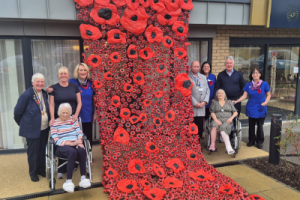
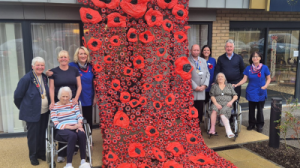
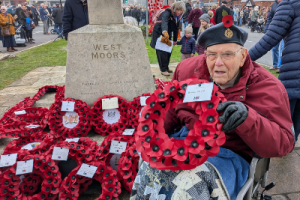
As well as the reminiscence activities, Abbotts Barton residents marked Remembrance this year with poppy making, poetry and the laying of wreaths around a memorial flag in the garden.