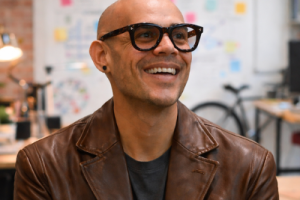



Isaac Samuels, Partner at Co-Production Collective, explores how anti-racist co-production can challenge power, centre lived experience and create meaningful change across health and social care.
Social care has a storytelling problem. Not because it lacks stories — quite the opposite. The sector is full of them. But too often, the stories being told about communities, about need, and about who counts as an expert are shaped by systems and structures that have historically excluded the very people they claim to serve.
If we want to change how care is understood, delivered, and governed, we have to change who gets to hold the pen.
That is what anti-racist co-production is about.
Where This Work Began
In October 2023, Co-Production Collective launched a project in partnership with People’s Voice
Media to understand the experiences of individuals from racialised backgrounds and global majority communities within co-production spaces. It emerged from a simple but urgent concern: that racialised people were experiencing harm in rooms that were supposed to be safe, equitable, and collaborative.
Over the course of a year, myself and Samantha-Jane Ofoegbu gathered more than 37 personal stories. We ran sense-making workshops and held two “Conversations of Change,” where people responded to our initial findings and pushed us further.
What emerged was not a dry audit. It was a portrait of systemic exclusion playing out in rooms full of people who believed they were doing good work.
One comment from those conversations has stayed with me ever since:
“You can’t do co-production without talking about racism.”
True co-production must start with an honest conversation about race and power.
What the Stories Revealed
The racism documented in this work is not always loud or intentional. It lives in who speaks first and who waits until the door is nearly closed. It lives in whose discomfort gets centred when race is raised, and whose expertise is treated as anecdotal rather than authoritative.
People spoke of tokenism — of being the only Black or Brown person in a room while discussions about “equality and diversity” circled around everything except race. Of the exhausting double burden of contributing lived experience while also managing the weight of making the room feel safe for everyone else.
Participants shared a common belief: that co-production spaces often maintain hierarchies and retain power imbalances — the very hierarchies these spaces were designed to dismantle.
If co-production is the mechanism by which we are meant to correct these inequities, then it must itself be anti-racist. Otherwise, we are simply replicating the problem in a different room.
From Stories to Action
Informed by the stories and sense-making work, four core recommendations emerged.
Centre the voices of racialised individuals. Their perspectives must be integral to the process, not an afterthought.
Create spaces for open dialogue about race. Conversations around racism and power dynamics should not be avoided or glossed over. Organisations need to create environments where these discussions are welcomed, even when uncomfortable.
Commit to anti-racism as an ongoing process. Anti-racism work is not a one-off event. It is a continuous commitment.
Empower Global Majority leadership. People from the global majority should not only be included but empowered in leadership roles — not as consultees, but as architects.
From Involvement to Leadership
Lived experience brings something that no policy document, audit, or consultation exercise can replicate: the knowledge of what it actually feels like to need, use, or be failed by a care service.
But lived experience leadership has to mean leadership — not just involvement. Not a seat at the table where the agenda has already been set, but genuine power to influence what gets discussed, what gets resourced, and what gets changed.
The most common mistake is treating inclusion as a communications challenge rather than a power challenge. Organisations diversify their imagery, add a lived experience advisory group, use the right language in their strategies — and assume the job is done. But representation without redistribution of power is performance, not progress.
Genuine inclusion requires psychological safety. It requires flexibility. It requires payment. And it requires accountability.
Turning Words into Action
Since the report was published in February 2025, a Global Majority-led Anti-Racism Working Group has been established — made up of racialised co-producers, white allies, staff members, and academic partners at UCL. This was a deliberate shift in power: decisions about anti-racist practice should be led by those most affected by racism, not designed on their behalf.
Community Commitments and Collective Safety Tips followed. These are not abstract value statements. They are tools for accountability, used in real sessions and refined through ongoing feedback.
The Amplifying Voices Programme, launched in 2025 in partnership with People’s Voice Media and funded by the National Lottery, was designed for individuals from global majority communities who want to develop skills, deepen expertise, and make real impact. It is not a tokenistic involvement exercise. It is an investment in leadership.
This Work Is Never Finished
Individual organisations doing better is necessary but not sufficient. The narrative of social care will only genuinely shift when lived experience — in all its diversity — shapes policy at a system level.
That means commissioners and policymakers actively seeking out leadership from racialised communities, not just consultation at the end of a process. It means research frameworks that treat lived experience as evidence, not illustration. And it means sector leaders asking whose voices are shaping decisions, and who is still missing.
Anti-racism is not a training day or a strategy document. It is a sustained commitment to examine power, challenge assumptions, and keep asking whether the people most affected are the people with the most influence.
The story social care tells about itself is changing. Anti-racist co-production, grounded in lived experience leadership, is one of the most powerful ways to shape what that story becomes.