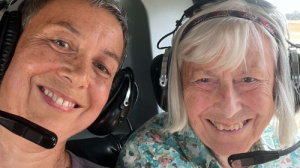

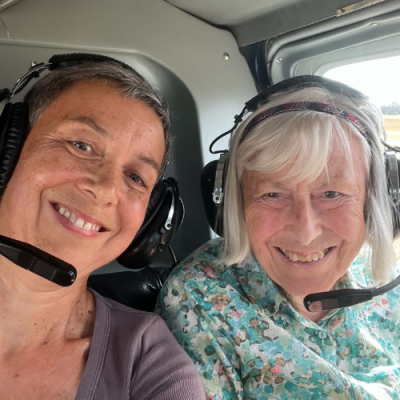

When 86-year-old resident Eileen arrived at Bottisham Airfield Museum near Cambridge this week, she was preparing to do something she had never done before: go for a ride in a helicopter. Eileen has always had an adventurous spirit, encouraging her two daughters, Elaine and Fiona, to embrace every exciting opportunity they could.
Unfortunately, in recent years her reduced mobility has made it harder for Eileen to keep up with her daughters’ adventures. When we asked her about an activity she would dearly love to try, a helicopter flight quickly emerged as the perfect choice. Growing up in Australia, she would often watch helicopters flying overhead and wonder what it would be like to see the world from that height. Having never had the opportunity herself, Eileen jumped at the chance to finally take to the skies.
Eileen’s excitement said everything, but the experience also illustrates a larger principle: moving into a care home doesn’t mean a resident’s horizons have to shrink. Indeed, at Henbrook House we believe exceptional care is about expanding what feels possible for residents by helping them tick off those many ‘bucket-list’ items they thought they’d never manage.
Pursuing passions
Meaningful activity is very different from simply keeping someone occupied. According to NICE, meaningful activity in care homes involves physical, social or leisure activities tailored to an individual’s own needs and preferences. Done well, these experiences can provide emotional and intellectual stimulation while supporting the health and mental wellbeing of residents.
Crucially, however, what feels ‘meaningful’ has to be defined by the resident themselves. That means taking the time to understand their interests, passions and personal history – including long-held ambitions they assume are no longer possible.
For instance, the team at Henbrook House arranged for 94-year-old Joy Wilson to reconnect with an extraordinary passion stretching back more than 70 years. In 1952, when waterskiing was still virtually unknown in Britain, Joy became one of the first women in the UK to take up the sport and was a vocal champion during its early years.
Working with her son Neil and DAMS Watersports in Little Paxton, the team arranged for Joy to return to the water’s edge and watch a training session from the jetty. For Joy, this was far more than a nostalgic day out; it was a chance to reconnect with a defining part of her identity and celebrate a sport she had helped pioneer all those decades ago.
Keeping the past alive
Moving into a care home inevitably brings change, but that does not mean residents should have to leave their old lives behind. CQC guidance on person-centred care stresses the importance of understanding an individual’s personal history, preferences and aspirations, while supporting them to maintain the relationships that matter most.
That makes familiar traditions more important than they might first appear. These rhythms and routines can provide a vital sense of continuity, helping residents retain a firm connection to the life they knew while preserving greater choice and autonomy in how they continue to live.
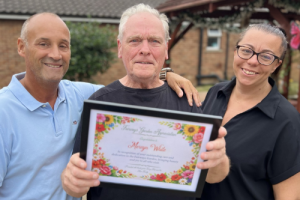
We saw this with 103-year-old resident Joyce, who has read The Mirror every day since 1944, when she first began following the paper as a way to feel connected to her husband Bernard after he left to serve during the Second World War. More than 80 years later, that daily ritual continues at Henbrook House. To celebrate it, our team tracked down and framed the newspaper’s front page from the exact day Bernard departed.
The significance was not simply the newspaper itself, but everything it represented: a familiar routine connecting Joyce with her husband, her memories and more than eight decades of her own life story.
Conclusion
Of course, arranging these kinds of experiences requires careful judgement and planning. Health, mobility, accessibility and fatigue all matter, especially for people living in care. Nevertheless, wherever possible we try to treat these obstacles as problems to be solved, rather than reasons not to try.
Eileen’s helicopter ride is a good example. While some might have looked at the situation and assumed her flying days were behind her, we knew that with careful planning and the right support there was no reason she could not do something that she had been dreaming about for years. Sharing the experience with her daughter made it even more special, creating a new memory for them both and showing that some of life’s best moments must be enjoyed together.
At Henbrook House, our ambition is to challenge the idea that entering residential care means retreating from ordinary life. A care home should instead provide a secure base from which life can continue – through familiar interests, stronger connections with family and friends, and new experiences that may once have seemed out of reach.
We also want to send the message that later life can still contain anticipation, achievement, romance, excitement and surprise. Exceptional care should be about making those moments not only possible, but expected.