

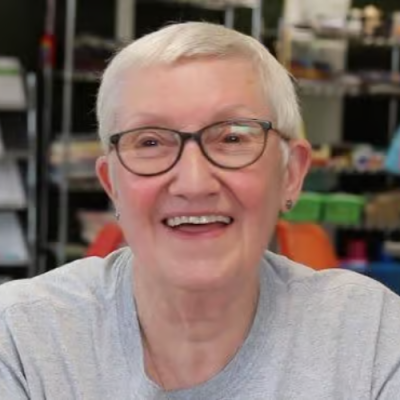

Jan Archibold, founder of Memory Action Group, shares how lived experience is shaping more compassionate, community-led dementia support.
Memory Action Group was inspired by the need to create a supportive and inclusive space for people living with dementia and their carers. When I founded the organisation in 2018, I wanted to address the lack of accessible, community-based peer support—somewhere people could feel understood, valued, and less isolated. The group aims to fill this gap by providing opportunities for social connection, shared experiences, and practical support in a welcoming environment.
Looking back, one of the most impactful achievements has been creating a supportive community where people living with dementia and their carers feel valued, understood, and less isolated. Seeing individuals build friendships, gain confidence, and enjoy meaningful social experiences together highlights the real difference the organisation has made.
For me, “leading the way” in community-based dementia support means allowing the person living with dementia and their carers to structure the way they are supported. Everyone is different, and all support needs to be personalised and tailored to each individual.
My personal experience has shaped everything I do. Having lived experience helps a lot in supporting others—knowing what it was like for me dealing with non-verbal communication, double incontinence, sleep deprivation, isolation and much more seems to mean something to other carers.
When it comes to formal services, I’m not sure we are too reliant—some carers really do need more from them than others. What I do feel strongly about is that people living with dementia should not be labelled. They live in the community and are part of the community. My dream would be for them to be accepted as anyone else.
I can’t stress the importance of peer support enough. I see friendships being made, people going on trips and holidays together—too nervous to go alone, but happy to go with others in a similar situation to provide mutual support. It opens up people’s lives and helps them all to live better, happier lives.
There are still significant gaps, particularly immediately after diagnosis. I am working, with others, to try and get a comprehensive, helpful pack to hand out at the time of diagnosis and for this pack to be available across all organisations supporting people living with dementia and their carers. At the moment, there is a lot of duplication, a lot of leaflets, a lot of information—and a lot of confusion.
I used to give talks as a JDR Ambassador, one of which was called ‘Discharge at Diagnosis’, because we are so often referred back to the GP—many of whom have little knowledge of dementia—to just ‘get on with it’.
There also needs to be more peer support groups. So often I hear, “You learn more from other carers than you do from any professional”—this needs to be available to everyone. These groups would certainly ease the load on the NHS and social care.
There is also a huge gap in supporting people who live alone and have no close relatives or carers. We also need to ask how we are supporting minority groups—there is still a lot of work to be done in these areas.
More support is needed for families when caring gets too much, and alternatives such as domiciliary care or care homes should be considered earlier.
Living with dementia is an expensive business—everything needs to be paid for. Trying to get Continuing Health Care from the NHS is nigh on impossible, as dementia doesn’t seem to be classed as a terminal or life-limiting condition. It falls through every crack, and families and carers have to deal with it as best they can.
Carers past retirement age often do not qualify for Carer’s Allowance because they receive the State Pension. The State Pension may be sufficient if you’re not caring, but costs mount when you are, and Attendance Allowance is insufficient to cover everything.
In the Wakefield area, most organisations are working together to ensure that people living with dementia and their carers are included in shaping the services they use. We’ve started, but we need to sustain the momentum and finish the task. Too often pilot programmes are run very successfully and then don’t continue due to lack of funding. If funding isn’t consistent, please don’t run pilot programmes—it’s not fair.
Balancing safety with independence is crucial. In partnership with Wakefield Hospice, we have developed a device called ReUnite—available as wristbands, badges and fobs—to help people living with dementia who may become disorientated, distressed or lost be reunited with their loved ones. We hope to see the scheme adopted nationwide, helping police forces reduce the number of 999 calls, supporting the Herbert Protocol, and encouraging communities to work together to keep each other safe.
Alongside this, Memory Action Group provides peer support groups where people living with dementia and their carers can meet, share experiences, and support one another in a friendly and social environment.
I definitely think we are still expecting too much of carers. Affordable or free respite is essential. There should be more opportunities for people living with dementia to spend time independently of their carers—if they didn’t have dementia, they wouldn’t spend all their time with their carers.
I found it so beneficial when my husband went out twice a week—he did his thing, I did mine, and then we came back together ready to carry on.
Looking ahead, I would most like to see society develop a deeper understanding and a more compassionate response to dementia. I envision a world where people living with dementia and their carers are valued, supported and included, with stigma replaced by awareness and empathy.
Society’s approach should focus not only on medical care, but also on meaningful social engagement, community support, and opportunities for people to live fulfilling lives for as long as possible.