
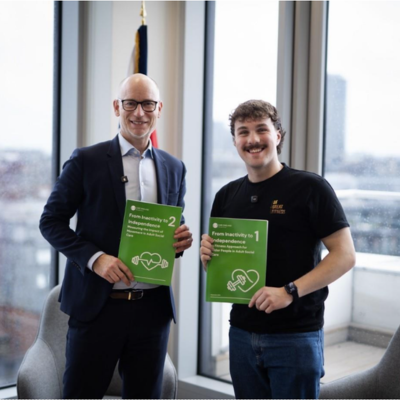

Care England has today launched the second white paper in its series From Inactivity to Independence, developed in partnership with Be Great Fitness and NHS Lincolnshire Trust, challenging the long-held assumption that frailty, decline and dependency in care homes are inevitable. The report sets out new evidence showing that structured, personalised movement can stabilise, and in some cases reverse, physical and behavioural decline among older residents living with advanced frailty, dementia and complex health needs.
The launch is being marked alongside a new interview between Bailey Greetham-Clark, Founder of Be Great Fitness and Care England Ambassador, and Stephen Kinnock MP, Minister for Care, exploring the future direction of adult social care and the role of prevention, community-based support, and physical activity in supporting independence and wellbeing. The programme evaluated in the report was delivered in collaboration with NHS Lincolnshire Trust, demonstrating how system partners and providers can work together to embed movement into everyday care practice.
In the interview, Stephen Kinnock highlights the need to shift the system away from hospitals and towards prevention and community-based care, describing adult social care as a vital part of making the health and care system work more effectively. He stresses that extending healthy life expectancy, “not just years on your life, but life in your years”, must be a core ambition for government and the sector, and that movement and prevention should sit at the heart of future reform.
The new white paper challenges the prevailing narrative that decline in care homes is unavoidable. Drawing on detailed case studies from multiple care settings, it documents consistent improvements in mobility, balance, confidence and engagement, alongside reductions in falls and distress-related behaviours. Improvements were also observed in sleep, continence, and nutrition, achieved without changes to medication, reinforcing the value of non-pharmacological approaches within a preventative, person-centred model of care.
The report suggests that much of what is often labelled as “inevitable decline” is in practice driven by prolonged inactivity and low expectations within care environments. In several cases, residents who had previously been largely cared for in bed or highly dependent on staff, were able to regain routine, strength and elements of independence once movement was embedded into everyday care.
Professor Martin Green OBE, Chief Executive of Care England, said:
“This second white paper directly challenges something we have become too ready to accept, that decline in care homes is inevitable. What this evidence shows is that when movement is embedded into everyday care, people respond. Residents stabilise, falls reduce and quality of life improves, without changes to medication. That is empowering for residents, motivating for staff, and points to a different model of care, one that focuses not on managing decline, but on sustaining independence for as long as possible.”
Bailey Greetham-Clark, Founder of Be Great Fitness and Care England Ambassador, said:
“This white paper shows that people do not stop responding because they are older or frail. When movement is delivered consistently and in a way that feels achievable, confidence returns, and progress follows. We have seen residents reconnect with their bodies, their routines and their relationships. This report is about making movement a fundamental part of care, not an optional extra.”
The movement programme examined in the report was delivered through a partnership model, with specialist instructors working alongside care staff to embed achievable, personalised movement into daily routines rather than limiting activity to occasional scheduled sessions.
Care England is calling for movement-led care to be recognised as a core component of quality in adult social care, aligned with national priorities on prevention, falls reduction, reablement, and healthy ageing. The organisation argues that embedding physical activity into everyday care practice can support independence, improve wellbeing, and reduce avoidable demand on the NHS.
This publication forms the second white paper in Care England’s From Inactivity to Independence series, building on the first report’s focus on embedding movement in care settings. Together, the series challenges the sector and policymakers to move beyond a model of care centred on managing decline, towards one that actively supports capability, confidence and independence for as long as possible.
See the new report here, the other report in our series here, the Minister Kinnock interview here, and a deep dive of what was discussed in the interview, and what it means for adult social care here.